Upholding the Dharma: The Inspiring Story of North East India’s Buddhist Nuns
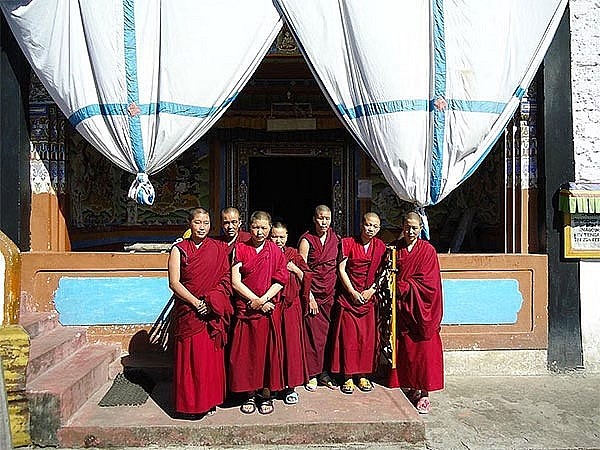 |
| Buddhist Nuns at monastery in Tawang, Arunachal Pradesh |
Today, however, the landscape is changing, thanks to the growing presence and activism of Buddhist nuns in the region. These women are challenging long-held beliefs about the role of women in Buddhist practice and carving out new spaces for themselves within the tradition. In doing so, they are defying patriarchy and upholding the dharma, the Buddha’s teachings on the path to liberation.
At the forefront of this movement is the Jangchub Choling Institute, also known as Gyangong Ani Gompa, a Buddhist nunnery located in the town of Tawang of Arunachal Pradesh. Founded in 1993, the nunnery has become a hub for Buddhist education and practice, attracting women from across North East India and beyond. Today, it is home to over 200 nuns, making it one of the largest and most influential institutions of its kind in the region.
Legend has it that Merak Lama Lodroe Gyatso had a sister who was a nun. As no woman could reside in the Tawang monastery, he constructed a meditation cave for his sister. She was provided provisions from the Tawang monastery. As the number of nuns residing in the meditation retreat constructed by Merak Lama for his sister increased with the passage of time, it eventually turned into a nunnery and came to be known as Jangchub Choeling / Gyangong Ani Gompa.
The nuns of Jangchub Choling are not just studying the dharma; they are actively engaged in spreading it to their communities. Through their work in schools, hospitals, and orphanages, they are bringing the teachings of the Buddha to those who might not otherwise have access to them. They are also breaking down barriers between different Buddhist schools, and collaborating with monks and nuns from other traditions to promote greater understanding and harmony.
But the path to this kind of engagement has not been easy. The nuns of Jangchub Choling have had to overcome significant obstacles to achieve the level of autonomy and recognition they enjoy today. For many years, they were forced to rely on the support of local monasteries, which often provided them with inadequate facilities and resources. They were also excluded from certain rituals and ceremonies, and their voices were often silenced within their own communities.
Despite these challenges, the nuns of Jangchub Choling persevered. They formed their own governing body and developed their own curriculum, which includes not just traditional Buddhist studies but also subjects like English, computer skills, and social work. They also took on leadership roles within the nunnery, serving as administrators, teachers, and mentors to younger nuns.
Perhaps most importantly, they have challenged the patriarchal assumptions that have long been embedded within the Buddhist tradition. They have shown that women can be just as committed, knowledgeable, and capable as men when it comes to the practice of dharma. They have also reimagined the role of women within Buddhist communities, asserting that nuns can and should be leaders in their own right.
The nuns of Jangchub Choling are not alone in their efforts. Across North East India, Buddhist nuns are challenging patriarchal norms and creating new spaces for themselves within the tradition. They are doing so not just through their activism, but also through their embodiment of the dharma. By living a life of mindfulness, compassion, and wisdom, they are demonstrating that women can be just as dedicated and skilled as men when it comes to spiritual practice.
Of course, there is still much work to be done. Patriarchy is deeply entrenched in many aspects of North East Indian society, and the Buddhist tradition is no exception. Women continue to face barriers to full participation in religious life, and their contributions are often overlooked or undervalued.
The Buddhist nuns of North East India are transforming the landscape of Buddhist practice in the region. Through their dedication to the dharma, their activism, and their embodiment of the teachings, they are challenging patriarchal assumptions and creating new spaces for themselves within the tradition. Their achievements are a testament to the power of spiritual practice to effect positive change, not just in the lives of individuals but in the broader social and cultural contexts in which we live. As we celebrate their accomplishments, let us also commit ourselves to support their ongoing efforts to promote equality and justice within the Buddhist community and beyond. (ANI)
The post Upholding the Dharma: The Inspiring Story of North East India’s Buddhist Nuns appeared first on Vietexplorer.com.
View more from VietExplorer:
Hanoi greets nearly 31,500 foreign tourists during SEA Games 31Domestic tourists prefer central coastal localities, staycations to famous destinations for Vietnam’s ongoing holiday
Vacationers turn to indoor destinations due to cloudy, rainy weather in Da Nang
Va-va-vovinam: Vietnam’s martial art flies on SEA Games return
Muoi Sau sweet soups- the quintessence of Hanoi’s nosh
Cyber risks threaten many Vietnamese government websites
Photo exhibition on female athletes underway to welcome SEA Games 31
First Border Hoa Sim Festival to be held in Mong Cai
Nine short film projects on environment receive support
Leading opera singers of Vietnam to gather at ‘Sparking Night’ concert
Vietnam keeps sitting atop SEA Games medal table with 188 golds
Exhibition introduces land and culture of Vietnam to French people
FIFA Mons to return to Vietnam
Calligraphy and Graffiti find “empathy”
Various activities in Hanoi to celebrate children’s day
Hung Temple mobile app makes debut
Three Vietnamese specialties among world best dishes: CNN
Take a stroll down new pedestrian street around centuries-old citadel in Hanoi
Vietnam subdue Thailand to strike gold for 2nd successive time in SEA Games men’s football
National press festival looks forward to unity, professionalism, modernity and humanity


Comments
Post a Comment